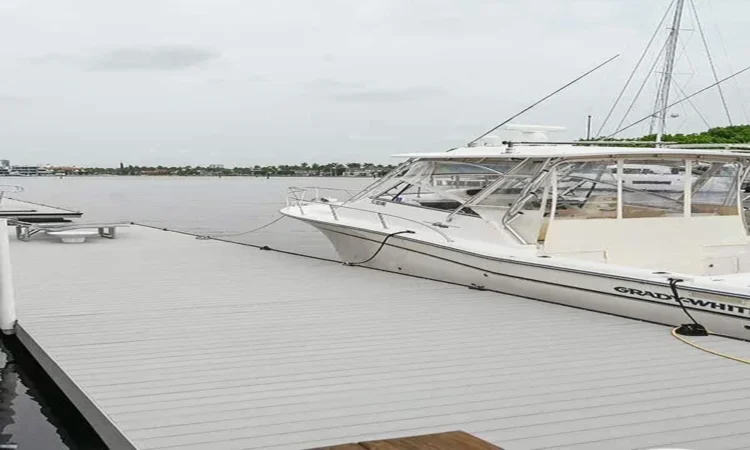
People who are new to waterfront living often ask what a floating dock actually is and how it differs from the fixed docks they see along the canal.
A floating dock is a platform that sits on top of the water, held up by floats. Pilings, anchors or arms keep it in place, but it moves up and down as the water level changes. A fixed dock, by contrast, is built on pilings driven into the bottom and stays at one height no matter what the tide is doing.
That single difference shapes almost everything else. On a floating dock, the height above the water stays about the same, so stepping onto a boat feels the same at high tide and low tide. On a fixed dock, the step can get large when the water drops, which matters a great deal for children, older family members and pets.
Floating docks tend to suit places where water levels swing, such as tidal canals, lakes that rise and fall and busy marinas. They also work well in deep water, where a fixed dock would need very long pilings.
Fixed docks still make sense in some settings. Very shallow water can leave floats resting on the bottom, and some exposed sites handle a fixed structure better. Plenty of properties use both, with a fixed pier from shore and a floating section at the end joined by a gangway.
Upkeep differs as well. Many floating systems use modular parts that can be replaced one section at a time instead of rebuilding the whole dock.
Supreme Floating Docks builds residential and commercial floating docks in South Florida and helps owners work out which setup fits their site, their boat and the way they use the water.