Commercial Roller Shutters: How to Choose the Right Profile for Your Business

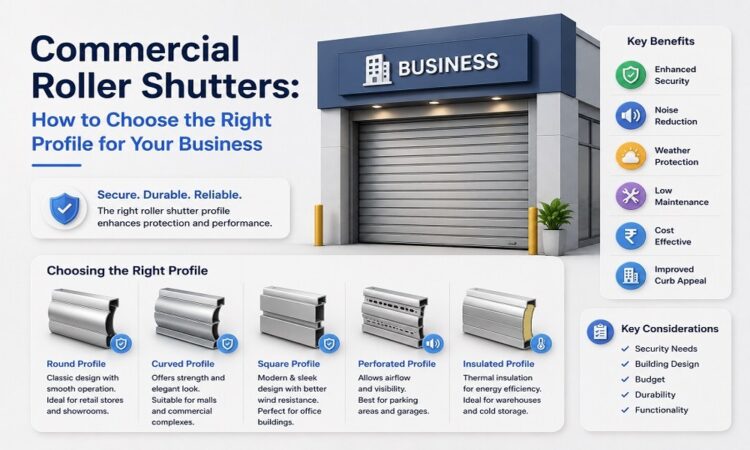
Securing a commercial premises is a more complex brief than a residential one. A break-in doesn’t just mean a broken window – it can mean lost stock, damaged equipment, insurance claims, and days offline. Commercial roller shutters are designed to address that risk, but specifying the wrong product leaves you with a solution that’s either inadequate for the threat or unnecessarily over-engineered for the application.
This guide breaks down the main commercial shutter profiles and helps you work out which fits your premises.
Extruded vs Roll-Formed: Why It Matters
The most important distinction in commercial specification is between extruded and roll-formed slat profiles. Roll-formed slats are bent from sheet aluminium – lighter and less expensive, suitable for light commercial and residential use. Extruded profiles are pushed through a die at high pressure, producing a denser, more uniform slat with consistent wall thickness and significantly better resistance to forced entry, wind load, and impact.
For the vast majority of commercial premises, extruded profiles are the minimum sensible specification. Within extruded options, the slat width determines how the shutter performs across different opening sizes and operational requirements.
36mm Extruded Vision Roller Shutters
The 36mm extruded vision roller shutter has become the benchmark for retail shopfronts. The slat profile incorporates a clear polycarbonate vision strip, maintaining some window display visibility even when the shutter is fully closed. This changes the character of the shopfront after hours – your products remain partially visible, internal lighting stays effective, and the overall look is more professional than a solid opaque curtain.
It’s particularly suited to fashion retail, cafés, service businesses in strip shopping precincts, and any setting where visual presence after hours carries commercial value. From a security standpoint, the extruded profile provides substantially better forced-entry resistance than roll-formed alternatives.
50mm Extruded Vision Roller Shutters
The 50mm extruded vision roller shutter serves a similar purpose to the 36mm but is optimised for wider openings. The larger slat profile means fewer slats per metre of height, reducing curtain weight and motor load over time. For openings wider than three metres – common in car showrooms, large retail outlets, and bulky goods precincts – the 50mm profile delivers better structural performance without sacrificing visibility.
Both 36mm and 50mm vision strips use impact-resistant polycarbonate, not standard perspex. Polycarbonate is harder to shatter and significantly more UV-resistant – an important consideration for Australian conditions where standard acrylic yellows and becomes brittle within a few years.
77mm Widespan Roller Shutters
At the heavy-duty end, the 77mm extruded vision roller shutter is designed for large commercial and industrial openings where structural performance takes priority. Commonly specified for warehouse loading docks, large-format retail, and industrial service openings, this profile covers wide spans without intermediate support posts.
Widespan installations require engineering input for guide fixings, a larger header box, and careful motor specification matched to curtain weight. An experienced commercial installer will work through these requirements during the quoting process – don’t accept a fixed price without confirmation that load calculations have been done.
Cyclone-Rated Shutters for Exposed Sites
A cyclone roller shutter is engineered to a specific wind-pressure rating and certified under Australian Standards. The key differences from a standard commercial shutter include reinforced slat profiles, heavy-duty guide systems with deeper track engagement, and locking mechanisms designed to resist lateral forces.
While cyclones are primarily associated with the Pilbara and Kimberley, severe storm events affect commercial properties across Western Australia. For businesses in exposed coastal, elevated, or wind-corridor locations, a certified cyclone-rated product is worth serious consideration regardless of your postcode.
Access Control and Motorisation
For commercial applications, the access control specification matters as much as the shutter profile. Key switches, coded keypads, and building management system integration all provide different levels of control and auditability. Timer-based automation – setting opening and closing to align with trading hours – reduces dependence on staff remembering to secure the premises at the end of the day.
Final Thoughts
The most common commercial roller shutter mistake is under-specifying to save installation cost. A lighter product that fails under attack, a motor that burns out from an undersized specification, or a shutter that doesn’t meet building code requirements for your site all create far greater costs down the track than the saving at installation. Work with a supplier who asks the right questions about your premises before recommending a product.