Most people have never watched a professional tree removal from start to finish. It looks straightforward from a distance: a tree goes up, then it comes down. In reality, the process involves careful planning, specialist equipment, trained climbers, and a precise sequence of work that keeps people, property, and surrounding trees completely safe. Here is exactly what happens, from the initial site visit to the final clear-up.
The Initial Assessment and Survey
Before any chainsaw starts, a qualified arborist visits the site to assess the tree and its surroundings. This is not a quick glance. The arborist examines the species, height, diameter, and overall condition of the tree. They check for decay, disease, structural weakness, and root damage. They also look at what surrounds it: overhead power lines, neighbouring structures, boundary fences, underground utilities, and the condition of the ground itself.
This assessment determines the removal method, equipment, the number of operatives, and whether any permissions apply. In conservation areas or where a Tree Preservation Order (TPO) is in place, the arborist will confirm whether planning permission from the local authority is needed before work begins. Removing a protected tree without consent carries a significant fine, so this step is non-negotiable.
The survey also produces a risk assessment and method statement, which professional companies prepare as standard before starting any job.
Preparing the Site
On the day of removal, the team arrives and sets up the work zone before touching the tree. This means establishing a clear exclusion zone around the base of the tree, typically extending well beyond the anticipated fall area. Cones, barriers, or tape mark the perimeter. Anyone not directly involved in the work stays outside this zone throughout.
The team checks equipment: chainsaws, ropes, rigging hardware, harnesses, helmets, ear defenders, visors, and chaps. All climbing equipment meets LOLER regulations and is inspected before use. If a cherry picker or elevated work platform (EWP) is required, it moves into position at this stage. Ground protection mats go down to prevent damage to lawns and driveways from heavy machinery.
The Removal Process Itself
How the tree actually comes down depends entirely on the space available and what surrounds it.
Where there is sufficient clear space and no risk to structures, the arborist may opt for a straight fell. This involves cutting a directional notch on the side facing the intended fall direction, followed by a back cut. Wedges control the fall precisely. The tree drops in a single, planned movement.
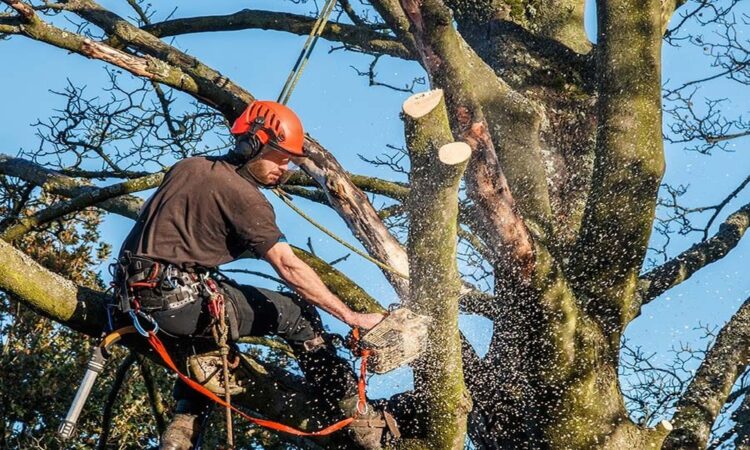
In most domestic and urban situations, a straight fall is not possible. Instead, the team uses sectional dismantling, which is the most common method used in gardens and built-up areas. A climber ascends the tree using ropes and a harness, working from the top downwards. Sections of the tree are cut and either lowered on ropes in a controlled descent or dropped into a designated clear zone below. The climber moves down the tree progressively, removing branches first, then working through the main stem in manageable sections.
For trees positioned very close to buildings or over rooftops, rigging systems come into play. These use pulleys, friction devices, and anchor points to lower heavy sections with absolute precision. An experienced rigger on the ground controls the descent of each piece, ensuring nothing swings, drops, or contacts the structure below.
Stump Treatment Options
Once the tree is down, the stump remains. The team will discuss the options with you. Stump grinding is the most thorough solution. A stump grinder, either a self-propelled walk-behind model or a larger tracked machine, chews the stump down to approximately 150 to 300mm below ground level, turning it into wood chips. This allows the area to be turfed, planted, or paved over cleanly.
The alternative is chemical stump treatment, which involves drilling holes into the stump and applying a potassium nitrate-based product. It accelerates natural decay. This takes considerably longer, typically six to twelve months, but suits situations where a grinder cannot access the area.
Clearing the Site
A professional team does not leave until the site is clean. All timber, brash, and wood chips either go into a chipper on site or are loaded for removal. Many companies offer to leave chipped material behind if you want it for garden mulch. Larger sections of timber can sometimes be cut to log lengths for firewood, depending on the species and your preference.
The team rakes the area, removes all ground protection, and checks the site carefully before packing down. What takes a full day of skilled work leaves behind nothing but a cleared, tidy space where a tree once stood.
What Qualifications Should the Team Hold?
Any professional tree surgeon carrying out this work should hold NPTC (National Proficiency Tests Council) certificates for chainsaw use and aerial tree work as a minimum. Look for membership in the Arboricultural Association, which sets industry standards and requires members to maintain current qualifications and insurance. Full public liability insurance of at least £5 million is standard for reputable companies. Always ask for proof before work begins.
How Long Does It Take?
A small garden tree might take two to three hours from set-up to clear-up. A large mature oak in a complex location could occupy a full team for an entire day. The honest answer depends entirely on the tree, the access, and the method required. A good arborist will give you a realistic time estimate during the initial assessment, along with a fixed, itemised quote covering all stages of the work.