Gold Coast arborists who have worked the same suburbs for a decade or more share a particular observation – the properties that generate emergency callouts are rarely ones where trees were neglected entirely. More often, they are properties where work was done, but done incorrectly, and the consequences took three or four growing seasons to fully materialise. Tree cutting in Gold Coast sits in a category where a bad decision looks fine for years before it does not, and by that point, the failure is rarely minor.
Decay Columns Start at the Cut
There is a specific reason why the placement of a pruning cut matters beyond tidiness. The branch collar – that slightly raised ring of tissue where a branch meets the parent stem – is not cosmetic. It is where the tree concentrates the phenolic compounds and specialised cells responsible for compartmentalising wounds. Make the cut through the collar rather than just beyond it, and that entire chemical defence system gets removed with the branch. What follows is not immediately visible. A decay column establishes itself in the exposed wood, and because wood decay fungi work from the inside outward, external bark can look completely intact for several years while the internal structure deteriorates progressively towards the heartwood.
Topping Creates the Next Hazard
The aftermath of topping is something Gold Coast arborists see regularly on properties that have changed hands without full disclosure of previous work. Topping cuts through the main stem at an arbitrary point, removing the apical structure and triggering dense epicormic regrowth from latent buds below. That regrowth attaches through callus tissue rather than interlocking wood grain. Tree cutting in Gold Coast is performed by operators who understand tree mechanics, never topping – they reduce lateral branches large enough to assume terminal roles, maintaining the tree’s structural architecture while achieving the size reduction. The distinction between these two approaches becomes starkly apparent during the first significant storm after topping regrowth has added several seasons of weakly attached canopy weight.
Wet Season Timing Has Consequences
This is a consideration that rarely appears in a quote or job discussion, yet it materially affects outcomes for several species common to south-east Queensland. Fresh pruning wounds on certain eucalyptus species cut during high-humidity periods face significantly elevated fungal infection risk – ambient spore loads are highest during and after wet-season rainfall events, and wound surfaces dry slowly in persistent humidity. Borer activity in susceptible species also follows seasonal patterns that make particular cutting periods genuinely riskier than others. Qualified arborists working locally build species-specific timing awareness into their scheduling. Operators who do not have this knowledge book work when it suits the calendar rather than when it suits the tree.
Confined Removals Require Rigging
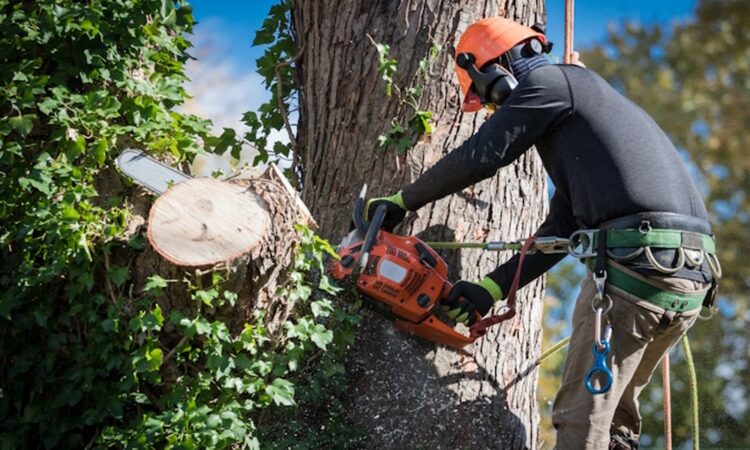
A tree growing in open space fails in a predictable direction when felled. A mature specimen growing against a boundary fence with a roof on one side and a neighbouring structure on the other fails into something expensive if the removal is not properly planned. Sectional dismantling in confined spaces requires assessing anchor points, calculating the load each rigging system must manage before the cut is made, and sequencing the work so that each removed section does not compromise the stability of what remains above it. The planning phase of a confined removal is where the actual skill lives – the cutting itself is straightforward once the rigging decisions have been made correctly.
Vegetation Overlays Are Property-Specific
Gold Coast City Council’s vegetation framework does not operate as a single blanket rule. Waterway corridor buffers, significant tree register listings, character residential precinct provisions, and biodiversity overlay categories each carry different requirements, and they can apply simultaneously to different trees on the same property. A tree that sits outside any protected category, three metres from the fence, may be adjacent to one that carries a register listing requiring formal application before any works proceed. Homeowners who discover this after cutting has already happened have faced remediation orders requiring replacement planting at maturity-equivalent specifications – an outcome that makes prior regulatory advice look considerably more worthwhile.
Conclusion
What makes tree cutting in Gold Coast a genuinely complex undertaking is the layering of biological, structural, seasonal, and regulatory variables that all apply simultaneously on a single property. The cut that looks clean on the day, the reduction that appears well-proportioned from the street, and the removal that seemed straightforward – all of these can carry consequences that only emerge later. Operators who understand this work accordingly. Those who do not leave behind problems that the next arborist, or the next storm, eventually reveals.