Gold Coast arborists will tell you something that most tree removal quotes do not mention – the stump is frequently the more consequential part of the job. Once the trunk comes down and the site gets cleaned up, attention moves elsewhere, and the stump sits there looking inert. In subtropical South East Queensland, ‘inert’ is rarely what it actually is. The conditions that make the Gold Coast such a productive growing environment work just as effectively on dead and decaying timber, and stump grinding in Gold Coast addresses consequences that most homeowners do not discover until they are already dealing with them.
Decay Moves Faster Than Expected
Timber decomposition in a temperate climate is a slow, relatively contained process. In south-east Queensland, the same process runs on a compressed timeline that regularly surprises people who have relocated from southern states. Warm soil, persistent humidity between rain events, and a fungal ecosystem that operates year-round rather than seasonally mean a stump can shift from solid to deeply compromised within a single year. The specific concern is not the visible decay – it is the hyphal networks that certain fungal species extend through soil from the decomposing stump into the root zones of adjacent healthy trees. Armillaria species, present across Queensland, are documented to spread exactly this way, and a neglected stump is a reliable vector.
Termite Risk Is Not Theoretical Here
South-east Queensland sits within the highest termite pressure zone in Australia – a classification that affects building codes, insurance requirements, and pest management protocols throughout the region. What is less commonly understood is the specific mechanism by which a stump elevates risk beyond general background termite activity. A stump with an intact root system provides a direct pathway that can extend beneath concrete, under slab edges, and alongside footings without any surface indication. Stump grinding in Gold Coast eliminates the food source and disrupts this root-based access route. Maintaining chemical barriers around a structure while leaving an adjacent stump untreated is a logical inconsistency that experienced pest managers consistently flag during inspections.
The Underground Activity Nobody Sees
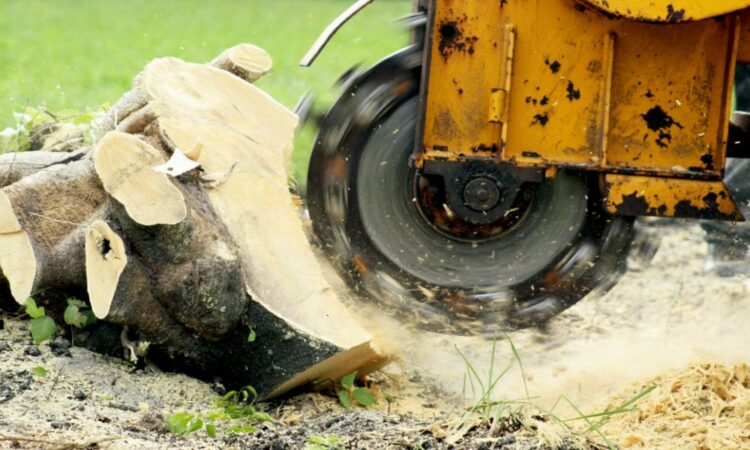
Root systems on established trees extend well beyond what the canopy suggests above ground, and biological activity within those roots does not cease immediately when a tree is felled. Depending on species, residual root activity – including continued cellular expansion as decay progresses – generates measurable lateral pressure on whatever is nearby. Irrigation lines, retaining walls, concrete edging, and path substrates are all susceptible. Professional grinding addresses the crown and upper root plate where active tissue concentration is highest, substantially reducing ongoing pressure without requiring excavation of the entire root system. The deeper structural roots decay passively over time without generating the same surface-level disruption.
Soil Subsidence Follows Stump Decay
This is a consequence that develops slowly enough that homeowners rarely connect it to its cause. As a stump and its immediate root structure decompose over several years, the soil volume they previously occupied reduces. The ground above subsides – not dramatically, but progressively and unevenly. On a Gold Coast property where the lawn or entertaining area borders the stump location, this creates surface irregularities that worsen incrementally. The problem is not just aesthetic. Uneven ground in outdoor living areas presents a genuine trip hazard, particularly relevant in households with older residents or young children who use the garden regularly.
Replanting Fails Without Proper Preparation
Nurseries and landscapers across the Gold Coast regularly encounter the same scenario – a homeowner plants a new tree or garden bed in the approximate location of a previous removal and then wonders why the establishment is poor. Decomposing root matter alters local soil pH in ways that are measurable but not visible. Physical root fragments obstruct new root penetration. The carbon-to-nitrogen ratio of decaying wood draws soil nitrogen away from new plantings during decomposition. Grinding the stump and working the resulting mulch into the soil addresses organic matter and soil structure simultaneously, giving new plantings a genuine start rather than a compromised one.
Conclusion
What makes stump grinding in Gold Coast a genuinely pressing consideration rather than a finishing detail is the specific environment in which stumps are left to sit. Fungal pathways, termite corridors, subsurface root pressure, and progressive soil subsidence are not theoretical risks in this climate – they are documented outcomes that play out on properties across the region regularly. Homeowners who address stumps promptly after removal avoid a category of problems that, once established, require considerably more intervention to resolve than the original grinding would have.